
Okay… this episode? Absolute spiral. No soft landing, no redemption arc tease. Just straight emotional freefall.
Let’s start with the question everyone’s asking: yes, Jim Dycker is dead. And not in a vague, “maybe he’ll wake up” TV way. He’s gone. The kind of ending that feels ugly and sudden, which honestly fits him.
But the real gut punch is not just that he dies. It is how we get there, and why Rishi is right in the middle of it when everything blows up.
How Jim Ends Up There (And Why It Was Inevitable)
Jim spends this episode acting like a man who already lost everything but hasn’t admitted it yet. Career? Torched. Reputation? Hanging by a thread. That big exposé energy he was riding earlier? Completely backfired. He pushed powerful people in public, and they crushed him like it was nothing.
So what does he do when the walls close in? He does not regroup. He does not think long term. He goes looking for noise. Alcohol, drugs, chaos, anything loud enough to drown out the fact that his life just collapsed.
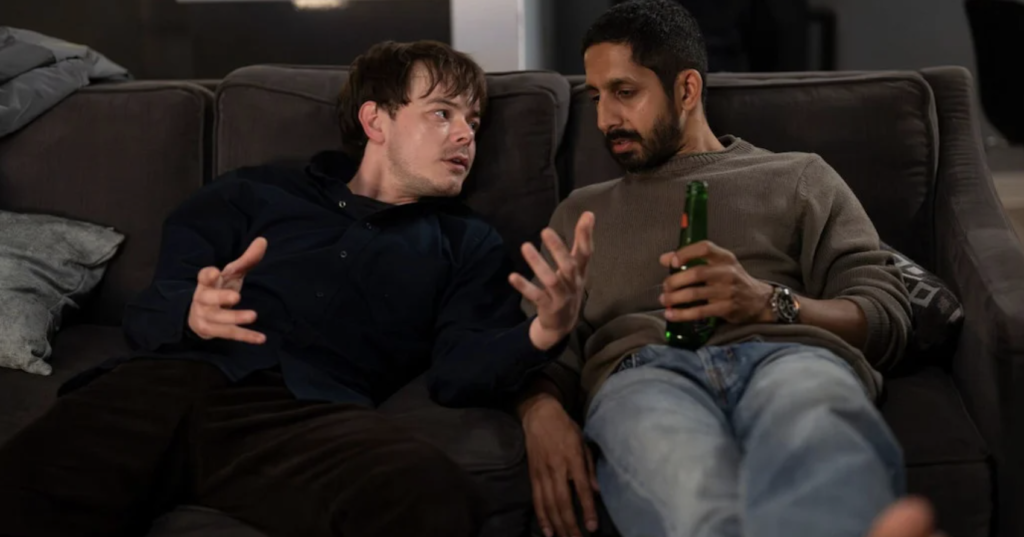
These two linking up is like watching two leaking gas tanks roll toward a lit match. They don’t even like each other that much, but they recognize the same thing: both are running from something they can’t fix. Jim’s shame. Rishi’s grief. Guilt. Rage. Take your pick.
Jim’s big ranty monologues about how nothing matters and everyone’s fake? That’s not insight. That’s a guy trying to convince himself his failures are proof the world is broken, not him.
And then he pushes too far.

There’s no dramatic music cue. No final speech. Just drugs, bad decisions, and a body that gives out. It’s bleak and messy, which makes it feel horribly real. Jim didn’t die chasing truth or exposing corruption. He died on a bender, burned out and alone. That’s the tragedy.
Why Rishi Was Even There
Rishi being in that room is not random. It’s the result of seasons of damage finally catching up.
This is a man who already lost his wife in a violent, traumatic way. Lost his son. Lost his career identity. Lost any version of the future that made sense. He’s basically been walking around like a ghost who still has a pulse.
So when he parties with Jim, it’s not “fun.” It’s anesthesia. If he can’t feel anything, maybe he doesn’t have to think about the wreckage of his life.
But the problem with numbing yourself is that reality waits. And it always shows up at the worst time.
The Moment Everything Breaks
Rishi steps away for a minute. Comes back. Jim is dead. Police are at the door. And right there, you can see his brain short-circuit.
Because this isn’t just “oh no, trouble.” This is confirmation of the story Rishi already believes about himself: that everywhere he goes, disaster follows. His wife died because of his mess. His kid’s life got ripped apart. Now he’s standing over another dead body.
He doesn’t see options. He sees the end of the line. So he runs. Not in a clever, calculated way. In pure animal panic. Balcony. Ledge. No plan. Just movement. Just escape.
Did Rishi Mean to Kill Himself?
This is where it gets complicated and painfully human.
That jump isn’t cleanly one thing. It’s not a calm, decided suicide attempt. But it’s also not a smart escape plan. It’s desperation exploding in real time.
Part of him probably did think, I can’t do this anymore. That weight has been crushing him all season. Another part, the survival instinct that’s kept him scrambling through every disaster, just wanted out of that room, away from those cops, away from one more moment he couldn’t survive emotionally.
So he jumps.
And he doesn’t die.
Which somehow makes it worse.
Both ankles shattered. Police slapping cuffs on him while he’s writhing on the pavement. No dignity. No release. Just more consequences, more pain, more living inside a life he clearly doesn’t know how to carry.
Where This Leaves Everyone
Jim’s story ends not with a bang, but with a whimper. A man who thought he was exposing the system gets swallowed by his own self-destruction instead.
Rishi survives, but survival isn’t mercy here. It’s punishment. He tried to outrun the wreckage again, and this time his body literally breaks under the weight of it.
The saddest part? Neither of them were villains in their own heads. Just men who kept making worse choices when better ones felt impossible.
And now one of them is dead, and the other is in handcuffs, staring at a future that somehow just got even darker.
That’s “Industry” at its most brutal: no heroic exits, no neat lessons. Just consequences.